













- What it is: A feeling of oral dryness caused by too little saliva, most often after radiation to the head and neck, and also from medicines or Sjögren's disease.
- Common symptoms: Dry or sticky mouth, trouble chewing, swallowing and speaking, altered taste, mouth burning, and more cavities and infections.
- Conventional care: Sipping water, local measures such as artificial saliva, the drug pilocarpine when these are not enough, and close dental care.
- How integrative care fits: Acupuncture and gentle traditional therapies may be added to medical and dental care to help with symptoms and comfort.
- Evidence at a glance: Limited for acupuncture, with two sham-controlled trials whose difference from sham was small or inconsistent and low-quality reviews; very limited for Ayurveda and herbal medicine.
What is Dry Mouth?
Dry mouth, or xerostomia, is the sensation of oral dryness that results from reduced saliva production, although some people feel dry without a measurable drop in saliva.[1] After radiation for head and neck cancer, it is a common and often long-lasting side effect that can affect eating, swallowing and speaking.[2]
Common symptoms
Dryness is the main complaint, along with a sticky mouth, mouth burning, difficulty swallowing, and loss or reduced sense of taste.[1] Radiation to the area can also cause related problems that affect eating and weight.[2]
- A dry, sticky or burning mouth, especially at night
- Difficulty chewing, swallowing or speaking
- Changed or reduced taste
- More tooth decay and mouth infections such as thrush[2]
Causes and risk factors
Dry mouth mainly comes from medicine side effects, from radiation therapy to the head and neck, and from Sjögren's disease.[1] Radiation damages the salivary glands, and effects can appear soon after treatment starts or months to years later.[2] This page focuses on dry mouth after radiation, but the same symptom can have other causes that your doctor or dentist should check.
How it is diagnosed and treated conventionally
Dry mouth is identified from your symptoms and an oral examination, and your care team looks for causes such as medicines.[1] Treatment aims to relieve symptoms, and complete resolution is not always achieved.[1]
Initial management includes education, such as sipping water regularly and avoiding tobacco, and local measures such as artificial saliva. Pilocarpine is used when local measures are not enough.[1] A dental professional on the oncology team helps prevent decay and other oral complications before, during and after radiotherapy.[2] One review concluded that no approved or definite treatment exists for cancer treatment-related xerostomia and that evidence for most proposed options is limited.[3]
Why Dry Mouth calls for a whole-person approach
Dry mouth rarely stands alone. It affects eating, swallowing, speech and dental health, and no approved or definite treatment exists for it, so care often combines several approaches.[2, 3]
Complementary care may fit alongside these measures. Its role is to support symptom relief and comfort, not to replace dental care or medical treatment.
Salivary gland damage
Radiation damages the glands that make saliva, so the problem is partly physical and may be long-lasting.[2] Reviews of future treatments are exploring ways to protect or restore the glands, but none is yet established.[3]
Eating, swallowing and nutrition
Dry mouth can make eating and swallowing harder and contribute to weight and appetite loss.[2] In one trial of a sesame oil wafer for dry mouth after head and neck cancer, swallowing scores improved and objective dryness improved, although the lozenge it was compared with also improved objective dryness.[4]
Dental and oral health
Reduced saliva raises the risk of decay and infection, so regular dental care is a core part of management.[2]
Stress and expectation
In sham-controlled acupuncture trials, patients given sham treatment also improved in some settings, which suggests that attention and expectation may play a role alongside any specific effect.[5]
Acupuncture for Dry Mouth
What the research shows
Research suggests acupuncture may reduce the feeling of dry mouth after head and neck radiation, but study quality is a concern. The strongest evidence is from two US-led sham-controlled trials. In a 2024 multicenter trial of 258 patients with chronic radiation-induced dry mouth at least a year after treatment, scores were lower with true acupuncture than with standard oral hygiene alone, and quality of life was higher. The difference from sham acupuncture was smaller and did not remain significant after adjustment for multiple comparisons.[6]
In a 2019 trial of 339 patients, acupuncture given during radiotherapy led to lower xerostomia scores 1 year later than standard care. It was marginally better than sham acupuncture, not significantly so. Results differed by site: the benefit over sham appeared in Shanghai but not in Houston, where the sham group also improved.[5]
Reviews are more cautious. A 2020 review of 8 trials with 725 participants (3 pooled in the meta-analysis) found that acupuncture improved symptoms compared with sham and with no acupuncture, but not objective salivary flow, and all trials had a high risk of bias.[7] A 2018 review of 10 trials in dry mouth from several causes rated the quality of the main outcomes as low and called the evidence inconclusive.[8] A 2022 network meta-analysis of 41 studies of acupuncture for radiotherapy side effects ranked acupuncture first for stimulated salivary flow, with a call for higher-quality studies.[9] A 2026 meta-analysis of 31 trials of several treatments found no single treatment, including acupuncture, with consistent benefit for xerostomia severity.[10] An overview of acupuncture reviews in cancer care found possible benefit for xerostomia but rated the reviews as mostly low quality.[11]
How acupuncture may work
How acupuncture might help dry mouth is not established. Reviewers suggest it may stimulate the salivary glands, and propose that clearer reporting and study design are needed to understand the effect.[12] These are proposed explanations, not settled facts.
What treatment involves
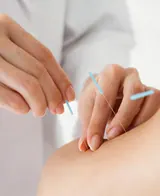
Treatment uses fine, sterile, single-use needles placed at points chosen for you, usually left in place for about 20 to 40 minutes. In the trials, patients had treatment two to three times a week over several weeks, and we reassess after a short course of visits.[5, 6]
Side effects are usually minor. In prospective studies, about 9 in 100 patients had a minor reaction such as bleeding, soreness or redness at a needle site, and serious events occurred in about 1 in 10,000.[13]
Tell the practitioner first if you have a low platelet count or low white blood cell count, a bleeding disorder, take blood thinners, have lymphedema, are pregnant, or have a pacemaker (relevant to electroacupuncture). Also tell the practitioner about any skin or tissue damaged by radiation, since needling in those areas needs particular care.
Ayurvedic medicine for Dry Mouth
The Ayurvedic view
In Ayurveda, oral conditions are described under mukharoga, and dryness is traditionally linked to aggravated Vata and depleted fluid tissues.[14] This is a traditional framework, not a biomedical diagnosis.
Therapies that may be used
Care is chosen for the individual and is gentle in this setting:
- Kavala (gargling) or gandusha (holding a liquid in the mouth) with preparations your oncology and dental teams agree are suitable
- Oil pulling with plain oil such as sesame, if you can swallow safely and have no open mouth sores
- Diet and daily routine favoring moist, warm, soft foods and steady hydration
- Individually prescribed herbal preparations, reviewed against your treatment and medicines
Panchakarma is not appropriate during pregnancy, acute illness, frailty or active cancer treatment, and we would not use it for this symptom.
What the research shows
The research on Ayurveda for dry mouth is very limited. A 2026 single-group study of 20 patients with radiation-induced dry mouth found improved symptoms and salivary measures after 30 days of an Ayurvedic gargle and lozenge, but it had no comparison group.[14] A 2023 unblinded randomized trial of 60 analyzed patients found an Ayurvedic mouthwash gave lower xerostomia and mucositis scores than a soda-salt mouthwash during chemoradiation, but without blinding.[15]
We found no systematic reviews of Ayurveda for radiation dry mouth. Because patients know which rinse they are using and symptoms change over time, these small studies cannot show that the Ayurvedic treatment caused the improvement.
Herbal medicine for Dry Mouth
Herbs and formulas that have been studied
Herbal research for dry mouth is small and mostly local: mouth rinses, gels and lozenges. A scoping review of local dry-mouth treatments listed natural agents such as thyme honey and ginger among those studied.[16] One trial studied an herbal compound of Malva sylvestris and Alcea digitata for dry mouth in head and neck cancer.[17]
What the research shows
The evidence is very limited. In the herbal-compound trial of 62 patients, symptom scores improved more than with artificial saliva over 4 weeks, and the authors reported that it supported the compound.[17] A scoping review found that local agents were useful for dry mouth sensation, with efficacy that varied between studies and few reported side effects, but warned that study designs were too different to compare.[16]
A 2026 meta-analysis of 31 trials of several treatments, including herbal formulations, found no single treatment with consistent efficacy for xerostomia.[10] An umbrella review of systematic reviews found only three high-quality reviews in the whole field and said that most reviews were of critically low quality.[18]
Safety and herb-drug interactions
Herbs are active substances, and in people with cancer the cautions matter more. Case reports describe bleeding when warfarin was combined with herbs including ginger, ginseng, dang gui, dan shen and Boswellia.[19] Tell us about every medicine you take, including pilocarpine, chemotherapy and blood thinners, and let your oncologist know about any herb before you start it. Rinses, gels and lozenges should also be checked with your oncology or dental team, especially if you have mouth sores or trouble swallowing.
In one study, about one fifth of Ayurvedic products bought online contained detectable lead, mercury or arsenic.[20] Herbs should come from tested sources and be prescribed individually. Tell us if you are pregnant or breastfeeding, or have liver or kidney disease.
Translating traditional medicine into modern biological language
The links drawn here are interpretation, not equivalence. Chinese medicine often describes dry mouth as a deficiency of body fluids and yin, sometimes with heat, and radiation is understood as a source of heat toxin. Researchers studying dry mouth instead look at damage to salivary gland tissue and the quantity of saliva produced.[2, 12]
Ayurveda's aggravated Vata and depleted fluids describe dryness and roughness of tissues. No study has shown that these concepts correspond to a specific biological process.
How this care fits with your medical care
For a condition like this, we ask that you are under a physician's care for it and that your treating team knows you are receiving complementary care. Integrative care is added to, never substituted for, your oncology, dental and medical care. Do not stop or change prescribed medicines, such as pilocarpine, or skip dental visits without your care team's advice.
We do not treat the cancer or diagnose the cause of dry mouth. Please bring your diagnosis, radiation history, a full list of medicines and supplements, and your dentist's recommendations. New mouth sores, pain or swallowing problems should be reported to your oncology or dental team.
When to seek urgent medical care
Some mouth and swallowing problems after radiation need prompt assessment.
- Trouble swallowing liquids or saliva, or unable to drink enough
- Mouth sores that do not heal, white patches, or new swelling
- Severe tooth, gum or jaw pain, or exposed bone in the mouth
- Fever or chills
- Weight loss that is rapid or unintended
- Trouble breathing
If any of these occur, call your oncology or dental team promptly. For an emergency, call 911 or go to the nearest emergency department.
Frequently asked questions
What is dry mouth?
Dry mouth, or xerostomia, is the sensation of oral dryness caused by reduced saliva. After radiation to the head and neck it is common and can last, and it can make chewing, swallowing, speaking and taste harder and raise the risk of cavities and infection. Medicines and Sjögren’s disease are other causes. Your doctor and dentist can look for the cause.
Can acupuncture help with dry mouth?
Research suggests it may. Two large sham-controlled trials in head and neck cancer found lower xerostomia scores with true acupuncture than with standard care, though the difference from sham was small or inconsistent. Reviews rate the evidence low in quality and found no clear gain in objective saliva flow. Acupuncture is used alongside medical and dental care.
Does Ayurvedic or herbal medicine work for dry mouth?
The evidence is very limited. A few small studies of Ayurvedic rinses and lozenges and of an herbal compound reported symptom improvement, but they were unblinded, single-group or compared with other products. Herbs can interact with blood thinners and other medicines, so they must be prescribed individually and reviewed by your oncology team.
Can I stop my pilocarpine or dental care if I have acupuncture?
No. Acupuncture, Ayurveda and herbal medicine are complementary care. Do not stop or change prescribed medicines, such as pilocarpine, or skip dental care without talking to your care team. Reduced saliva raises the risk of tooth decay, so dental care remains important.
How soon might I notice a change with acupuncture?
It differs from person to person and no result can be promised. In the trials, patients had two to three sessions a week over several weeks, and symptoms were measured at 4 weeks or later. We reassess after a short course of visits to see whether treatment is helping.
Does insurance cover acupuncture for dry mouth?
It may. Netra Integrative Health Clinic accepts most major insurance plans that include out-of-network acupuncture benefits, for example Aetna, Blue Cross Blue Shield, Cigna and UnitedHealthcare, and offers a free benefits check. HSA and FSA cards and CareCredit are also accepted. Call (908) 402-7301 to ask about your plan.
References
- Talha B, Swarnkar SA. Xerostomia. StatPearls [Internet]. 2023. PMID 31424871. StatPearls chapter on xerostomia covering its definition, symptoms, main causes and initial management with water, local measures and pilocarpine.
- Arya L, Brizuela M. Oral Management of Patients Undergoing Radiation Therapy. StatPearls [Internet]. 2023. PMID 36512664. StatPearls chapter on oral management during radiation therapy, describing xerostomia and other oral complications and the value of dental care on the oncology team.
- Hosseini MS, Sanaie S, Mahmoodpoor A, et al. Cancer treatment-related xerostomia: basics, therapeutics, and future perspectives. Eur J Med Res. 2024;29(1):571. PMID 39614391. 2024 review of cancer treatment-related xerostomia concluding no approved or definite treatment exists and that evidence for proposed options, including acupuncture, is limited.
- Abbas Amanat M, Srichana T, Takahashi Yupanqui C, et al. Comparison of sesame oil wafers and lozenges as saliva substitutes for dry mouth in head and neck cancer patients: A crossover randomized control trial. Pak J Pharm Sci. 2026;39(5):1460-1471. PMID 41879402. Crossover trial of 35 head and neck cancer patients comparing a sesame oil wafer with lozenges, finding better objective dryness and swallowing scores with the wafer.
- Garcia MK, Meng Z, Rosenthal DI, et al. Effect of True and Sham Acupuncture on Radiation-Induced Xerostomia Among Patients With Head and Neck Cancer: A Randomized Clinical Trial. JAMA Netw Open. 2019;2(12):e1916910. PMID 31808921. 2019 trial of 339 head and neck cancer patients finding true acupuncture during radiotherapy reduced xerostomia versus standard care, but not clearly versus sham.
- Cohen L, Danhauer SC, Garcia MK, et al. Acupuncture for Chronic Radiation-Induced Xerostomia in Head and Neck Cancer: A Multicenter Randomized Clinical Trial. JAMA Netw Open. 2024;7(5):e2410421. PMID 38739392. 2024 US multicenter trial of 258 patients with chronic radiation xerostomia comparing true acupuncture, sham acupuncture and standard care.
- Ni X, Tian T, Chen D, et al. Acupuncture for Radiation-Induced Xerostomia in Cancer Patients: A Systematic Review and Meta-Analysis. Integr Cancer Ther. 2020;19:1534735420980825. PMID 33307864. 2020 meta-analysis of 8 trials (725 participants) finding acupuncture improved xerostomia symptoms but not objective salivary flow, with high risk of bias.
- Assy Z, Brand HS. A systematic review of the effects of acupuncture on xerostomia and hyposalivation. BMC Complement Altern Med. 2018;18(1):57. PMID 29439690. 2018 systematic review of 10 acupuncture trials for xerostomia and hyposalivation, rating quality low and the evidence inconclusive.
- Wu T, Fu C, Deng Y, et al. Acupuncture therapy for radiotherapy-induced adverse effect: A systematic review and network meta-analysis. Front Public Health. 2022;10:1026971. PMID 36590000. Network meta-analysis of 41 studies of acupuncture for radiotherapy side effects, ranking acupuncture first for salivary flow, with a call for better studies.
- Shrateh ON, Habib A, Ur Rehman Shamsi H, et al. Treatment options for radiation-induced xerostomia in patients with head and neck cancer: a systematic review and meta-analysis. Br J Oral Maxillofac Surg. 2026;64(1):24-32. PMID 41253620. 2026 meta-analysis of 31 trials of treatments for radiation xerostomia finding no single intervention with consistent efficacy.
- Zhang XW, Hou WB, Pu FL, et al. Acupuncture for cancer-related conditions: An overview of systematic reviews. Phytomedicine. 2022;106:154430. PMID 36099656. Overview of 51 systematic reviews of acupuncture for cancer-related conditions, listing xerostomia as a possible benefit, with mostly low review quality.
- Zhang SQ, Chen HB, Liu J, et al. Research status and prospects of acupuncture for prevention and treatment of chemo- and radiotherapy-induced salivary gland dysfunction in head and neck cancer. Anat Rec (Hoboken). 2021;304(11):2381-2396. PMID 34626452. Review of acupuncture research for chemo- and radiotherapy salivary gland dysfunction, finding it beneficial but objective evidence insufficient.
- Bäumler P, Zhang W, Stübinger T, et al. Acupuncture-related adverse events: systematic review and meta-analyses of prospective clinical studies. BMJ Open. 2021;11(9):e045961. PMID 34489268. Systematic review of 21 prospective studies finding minor acupuncture reactions in about 9 percent of patients and serious events in about 1 per 10,000.
- Sivabalaji K, Ashwini BN, Nair AR, et al. Assessment of combined efficacy of Drakshaguduchyadi gargling and Khadiradi Vati lozenges in curative-intent radiotherapy-induced xerostomia in head-and-neck cancer. Front Med (Lausanne). 2026;13:1726247. PMID 41704690. Single-group study of 20 patients using an Ayurvedic gargle and lozenge for radiation xerostomia, reporting symptom and salivary improvement without a control group.
- Saniya CK, Rao MV, Patil R, et al. Evaluating Ayurvedic mouthwash and soda-salt mouthwash for oral mucositis in head and neck cancer: A randomized controlled trial. J Ayurveda Integr Med. 2023;14(6):100829. PMID 38029523. Unblinded randomized trial of 60 analyzed patients finding an Ayurvedic mouthwash gave lower xerostomia and mucositis scores than soda-salt rinse during chemoradiation.
- Niklander SE, Martínez M, Miranda A, et al. Treatment alternatives for dry mouth: A scoping review. J Clin Exp Dent. 2022;14(10):e846-e853. PMID 36320676. Scoping review of dry mouth treatments finding local agents useful but variably effective, including natural agents such as thyme honey and ginger.
- Ameri A, Heydarirad G, Rezaeizadeh H, et al. Evaluation of Efficacy of an Herbal Compound on Dry Mouth in Patients With Head and Neck Cancers: A Randomized Clinical Trial. J Evid Based Complementary Altern Med. 2016;21(1):30-3. PMID 26137850. Randomized trial of 62 head and neck cancer patients comparing an herbal compound with artificial saliva for dry mouth, reporting better symptom scores with the herbal compound.
- Conte DB, Marquezzan ME, Schneider LR, et al. Systematic Reviews on the Management of Xerostomia and Hyposalivation-An Umbrella Review. Gerodontology. 2025;42(2):165-176. PMID 39838537. Umbrella review of 48 systematic reviews on dry mouth, finding few high-quality reviews and low-quality evidence for a slight saliva increase with acupuncture.
- Milić N, Milosević N, Golocorbin Kon S, et al. Warfarin interactions with medicinal herbs. Nat Prod Commun. 2014;9(8):1211-6. PMID 25233607. Review of case reports of bleeding and other harms when warfarin was combined with medicinal herbs including ginger, ginseng, dang gui, dan shen and Boswellia.
- Saper RB, Phillips RS, Sehgal A, et al. Lead, mercury, and arsenic in US- and Indian-manufactured Ayurvedic medicines sold via the Internet. JAMA. 2008;300(8):915-23. PMID 18728265. JAMA study finding detectable lead, mercury or arsenic in about one fifth of Ayurvedic medicines purchased over the Internet.
This page is for general education and is not medical advice. Acupuncture, Ayurvedic medicine and herbal medicine are complementary therapies; they do not replace diagnosis or treatment by your physician. Do not stop or change prescribed treatment without talking to your prescriber. In an emergency call 911.