












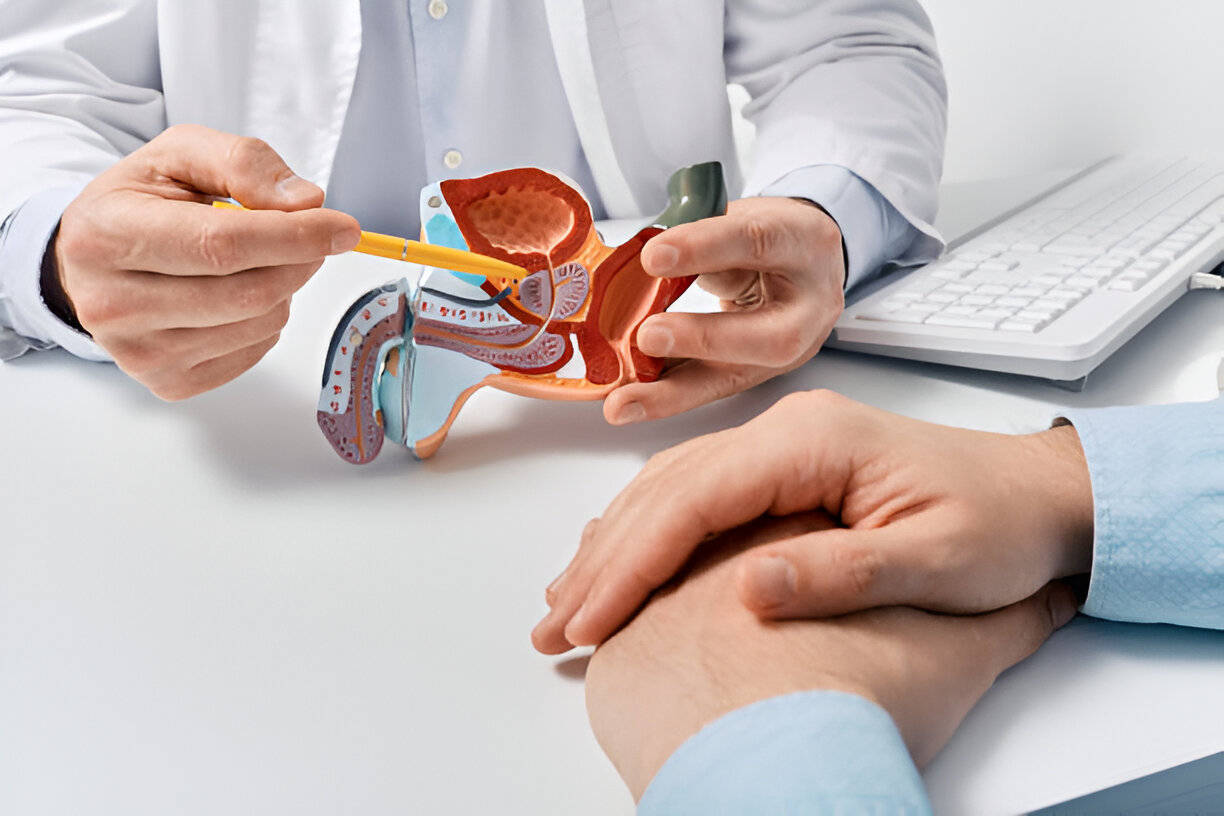
- What it is: Long-lasting pelvic or genital pain, with or without urinary and sexual symptoms, in a man whose tests show no other cause such as infection.
- Common symptoms: Pain in the perineum, testicles, penis or lower abdomen, urinary frequency or urgency, and sexual problems.
- Conventional care: Ruling out infection and other causes, alpha-blockers, pain medicines, pelvic floor physical therapy and tailored multimodal care.
- How integrative care fits: Acupuncture, Ayurvedic therapies and individually prescribed herbs are used alongside urologic care to help with pain, urinary symptoms and stress.
- Evidence at a glance: Strong for acupuncture in short-term sham-controlled trials and meta-analyses, mostly from China; limited for herbal medicine; none found for Ayurveda.
What is Chronic Prostatitis?
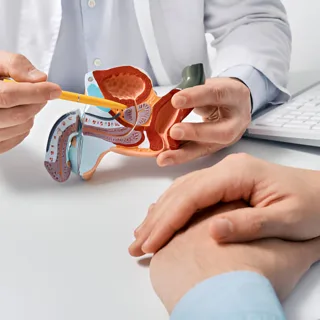
Chronic prostatitis is a group of conditions with long-lasting prostate-area pain, and the most common form is chronic prostatitis/chronic pelvic pain syndrome (CP/CPPS).[1] CP/CPPS means pelvic pain or discomfort for at least 3 months, often with urinary symptoms, and it is diagnosed when tests do not find another cause.[2]
Prostatitis as a whole is estimated to affect about 9.3% of men in their lifetime.[2]
Common symptoms
The main symptom is pain or discomfort in the pelvic area, which can include the perineum, the testicles, the penis and the lower abdomen.[2] Urinary symptoms such as frequency are common.[2]
Sexual problems are also common. A meta-analysis of 24 studies found sexual dysfunction in about 6 in 10 men with CP/CPPS, including erectile dysfunction in about 3 in 10 and premature ejaculation in about 4 in 10.[3]
Causes and risk factors
The cause of CP/CPPS is not well understood, and it is a heterogeneous condition in which different men have different contributing factors.[4] Bacterial prostatitis, by contrast, is an infection of the prostate that is treated with antibiotics.[1, 2]
Possible contributors include pelvic floor muscle tension, nerve sensitivity, inflammation and psychological stress.[4, 5] This is why a doctor tests for infection and other causes first.
How it is diagnosed and treated conventionally
CP/CPPS is a diagnosis of exclusion with no standardized treatment.[1] A physician takes a history, does a physical exam and checks urine for infection, and other causes such as cancer, blockage or retention are ruled out.[2]
Alpha-blockers are the usual first-line medicine for CP/CPPS with urinary symptoms. Other medicines, including anti-inflammatory drugs, pregabalin and pollen extract, give modest benefit over placebo.[2] Pelvic floor physical therapy, cognitive behavioral therapy and other approaches are also used, and specialists often combine them according to the man's symptom pattern.[4]
Why Chronic Prostatitis calls for a whole-person approach
Chronic prostatitis is a heterogeneous syndrome, and no single therapy works for everyone.[4] A system called UPOINT sorts patients into six domains (urinary, psychosocial, organ-specific, infection, neurologic or systemic, and tenderness of muscles), and therapy guided by it led to symptom improvement in about three quarters or more of patients in three studies.[4]
Care that looks at several factors at once is therefore a reasonable addition to the treatment your urologist directs.
Pelvic floor muscle tension
Tight pelvic floor muscles can cause pelvic pain, urinary and sexual symptoms.[5] A systematic review of pelvic floor physical therapy found it seemed beneficial in chronic prostatitis and pelvic pain syndromes, although most studies were small and at risk of bias.[5]
Inflammation and the immune system
Inflammation and immune function have been proposed as part of CP/CPPS.[6] A small study of 12 men looked at immune cell changes with acupuncture, but its authors said the specific effect remained unclear.[6]
Stress, mood and the nervous system
Psychosocial stress is one of the six UPOINT domains, and nerve-related and systemic factors are another.[4] Cognitive behavior therapy is one of the approaches used in multimodal treatment plans.[4]
Urinary symptoms
Frequency and other urinary symptoms are a main reason for treatment, and alpha-blockers are used for them.[2] Studies of acupuncture have measured urinary scores and flow rates as well as pain.[7, 8]
Sexual health
Sexual problems affect many men with CP/CPPS and add to stress.[3] They should be discussed with your physician, who can look for other causes.
Acupuncture for Chronic Prostatitis
What the research shows
Research suggests acupuncture can reduce symptoms of CP/CPPS in the short term. A Cochrane review of 38 non-drug trials found that, in the short term, acupuncture reduced symptom scores compared with sham (3 studies, 204 men, high-quality evidence) and compared with standard medical therapy (moderate quality).[9]
A multicenter sham-controlled trial of 440 men in China gave 20 sessions over 8 weeks. At week 8, about 61% of men in the acupuncture group had a clinically important improvement, compared with about 37% with sham, and the difference was still present at week 32. No serious adverse events occurred.[10] A smaller sham-controlled trial of 68 men found a symptom score difference of about 6 points at week 8 and benefit through week 32.[11] A trial of 100 men with category IIIB CP/CPPS reported that 92% of the acupuncture group and 48% of the sham group were responders 8 weeks after treatment.[12]
Meta-analyses agree. One of 10 high-quality trials (798 patients) found acupuncture better than sham acupuncture or Western medicine for pain, symptom score and quality of life, with mild adverse effects.[7] A review of 17 trials, mostly against medication rather than sham, found electroacupuncture beneficial, rating the evidence as medium quality.[8] Moxibustion, a warming technique, was also found promising in a review of 8 trials, but the authors called for better studies.[13]
Limits remain. Most trials are from China, treatment has been short-term, and one trial noted that sham acupuncture might have some physiologic effect.[10] A broader meta-analysis found a significant placebo effect across CP/CPPS outcomes.[14]
How acupuncture may work
How acupuncture helps CP/CPPS is not known. Researchers have looked at the immune system, and in a small study of 12 men acupuncture changed natural killer cell levels compared with sham, although the authors said its specific effect remained unclear.[6] This is a proposed explanation from a very small study, not a settled fact.
What treatment involves
Treatment uses fine, sterile, single-use needles placed at points on the lower abdomen, lower back, sacrum and legs, usually left in place for about 20 to 40 minutes. The largest trial gave 20 sessions over 8 weeks.[10] We reassess after a short course of visits.
Serious problems from acupuncture are rare. In prospective studies, about 9 in 100 patients had a minor reaction such as brief bleeding, soreness or bruising, and serious events occurred in about 1 in 10,000 patients.[15] Tell the practitioner first if you have a bleeding disorder, take blood thinners, or have a pacemaker (relevant to electroacupuncture).
Ayurvedic medicine for Chronic Prostatitis
The Ayurvedic view
Ayurveda has no single classical name for chronic prostatitis. Practitioners may describe long-lasting pelvic pain with urinary difficulty as a disturbance of Vata, the principle said to govern movement and the pelvic region, sometimes with Pitta or Kapha. These are traditional categories for choosing treatment, not biomedical diagnoses.
Therapies that may be used
Care is chosen for the individual and traditionally combines:
- Diet and daily routine, with regular meals, fluids and sleep, and attention to sitting habits
- Warm oil massage of the lower back and legs
- Warm sitz-style baths and local heat
- Herbs prescribed individually by a qualified practitioner
Panchakarma procedures are not appropriate during acute illness or frailty, and not while an infection is being evaluated or treated.
What the research shows
We found no clinical trials of Ayurvedic treatment for chronic prostatitis in PubMed. Without trials, no claim of benefit can be made, and specialists note that no therapy for CP/CPPS has level 1 evidence to guide care.[4] General self-care measures such as lifestyle changes and physical activity have been studied in CP/CPPS, but the Cochrane review rated that evidence as very low to low quality.[9]
Herbal medicine for Chronic Prostatitis
Herbs and formulas that have been studied
Chinese patent medicines and plant-derived products have been studied for chronic prostatitis. These include Ningmitai capsule, a Chinese formula, plant flavonoids, and grass pollen extract.[16, 17, 18]
What the research shows
The evidence is limited. A meta-analysis of 30 trials with 6,185 patients found Ningmitai capsule improved response rates in chronic prostatitis, especially when combined with other drugs; used alone, the pooled difference was not significant. The authors noted a need for higher-quality, blinded trials.[16]
A meta-analysis of 11 trials with 975 men found plant flavonoids improved response rates and symptom scores, with minor adverse effects. Results differed by type of prostatitis, and in CP/CPPS overall the response-rate difference was not significant, though it was in placebo-controlled trials.[17] An umbrella review concluded that evidence supports grass pollen extract for chronic prostatitis, and the JAMA review reports a modest benefit of pollen extract over placebo.[2, 18]
Safety and herb-drug interactions
Herbs are active substances and can interact with medicines. A literature review, mostly of case reports, found enhanced warfarin effect or bleeding with herbs such as dan shen (Salvia miltiorrhiza), garlic and ginkgo, and bleeding when ginkgo was combined with aspirin.[19] People taking blood thinners, alpha-blockers or other long-term medicines need a practitioner's review before using herbs.
In one study, about one fifth of Ayurvedic products bought online contained detectable lead, mercury or arsenic.[20] Herbs should come from tested sources and be prescribed individually. Tell us if you have liver or kidney disease, are allergic to pollen, or have surgery planned.
Translating traditional medicine into modern biological language
The links drawn here are interpretation, not equivalence. Chinese medicine often describes chronic prostatitis as damp-heat, qi and blood stasis, or kidney deficiency, depending on the person. Researchers instead study pelvic muscle tension, nerve sensitization, inflammation and immune signaling.[4, 6]
Ayurveda's Vata imbalance describes pain and movement problems in the pelvis, which loosely parallels the nerve and muscle-tension features seen in CP/CPPS.[5] No study has shown that a dosha or a TCM pattern corresponds to a specific biological process.
How this care fits with your medical care
Integrative care for chronic prostatitis is complementary. Keep your urologist or physician, and do not stop or change prescribed medicines without your prescriber. We do not diagnose the cause of pelvic pain or urinary symptoms, and a physician should first rule out infection, cancer, obstruction and other causes.[2]
Please bring your diagnosis, urine and prostate test results, a list of medicines and supplements, and notes on any pelvic floor therapy.
When to seek urgent medical care
Fever, chills and painful urination can signal acute bacterial prostatitis, which is treated with antibiotics.[2] Some other symptoms also need prompt evaluation.
- Fever or chills with pelvic pain or burning with urination
- Being unable to pass urine, or a very weak stream with a swollen lower abdomen
- Blood in the urine or semen
- Severe or rapidly worsening pelvic or testicular pain
- Pain and swelling in the scrotum, which can be an emergency
- Back pain with leg weakness or numbness, or loss of bowel control
If any of these occur, call 911 or go to the nearest emergency department.
Frequently asked questions
What is chronic prostatitis?
Chronic prostatitis is long-lasting pain or discomfort in the pelvis, perineum, genitals or lower abdomen, often with urinary and sexual symptoms. The most common form is chronic pelvic pain syndrome, in which tests show no infection. Doctors diagnose it by ruling out other causes. A man should be evaluated by a physician before starting any complementary care.
Can acupuncture help with chronic prostatitis?
Research suggests it may. A Cochrane review and several sham-controlled trials, including one of 440 men, found that acupuncture reduced symptom scores more than sham, with benefit lasting months after treatment. Most trials were done in China and sham treatments may have some effect. Acupuncture is used alongside medical care, not in place of it.
Does Ayurvedic or herbal medicine work for chronic prostatitis?
Ayurvedic treatment of chronic prostatitis has no clinical trials that we could find, so benefit is unknown. For herbal products, studies of a Chinese formula, plant flavonoids and pollen extract show some benefit, but quality is limited. Herbs should be prescribed individually and checked against your medicines.
Can I stop my medicine if I have acupuncture?
No. Acupuncture, Ayurveda and herbal medicine are complementary care. Do not stop or change prescribed medicines, including alpha-blockers or antibiotics, without talking to your prescriber. Fever, inability to pass urine or blood in the urine need prompt medical care.
How soon might I notice a change with acupuncture?
It differs from person to person and no result can be promised. In the largest trial, men had 20 sessions over 8 weeks, and benefit was measured at weeks 8 and 32. We reassess after a short course of visits to see whether treatment is helping.
Does insurance cover acupuncture for chronic prostatitis?
It may. Netra Integrative Health Clinic accepts most major insurance plans that include out-of-network acupuncture benefits, for example Aetna, Blue Cross Blue Shield, Cigna and UnitedHealthcare, and offers a free benefits check. HSA and FSA cards and CareCredit are also accepted. Call (908) 402-7301 to ask about your plan.
References
- Lam JC, Stokes W. Acute and Chronic Prostatitis. Am Fam Physician. 2024;110(1):45-51. PMID 39028781. American Family Physician review of acute and chronic prostatitis, noting CP/CPPS is the most common form, a diagnosis of exclusion without standardized treatment.
- Borgert BJ, Wallen EM, Pham MN. Prostatitis: A Review. JAMA. 2025;334(11):1003-1013. PMID 40788632. 2025 JAMA review of prostatitis covering definitions, diagnosis of CP/CPPS, first-line alpha-blockers and modest benefit from other drugs and pollen extract.
- Li HJ, Kang DY. Prevalence of sexual dysfunction in men with chronic prostatitis/chronic pelvic pain syndrome: a meta-analysis. World J Urol. 2016;34(7):1009-17. PMID 26546073. Meta-analysis of 24 studies finding sexual dysfunction in about 62 percent of men with CP/CPPS.
- Polackwich AS, Shoskes DA. Chronic prostatitis/chronic pelvic pain syndrome: a review of evaluation and therapy. Prostate Cancer Prostatic Dis. 2016;19(2):132-8. PMID 26951713. Review of CP/CPPS evaluation and therapy describing its heterogeneity and the UPOINT phenotyping system that guides multimodal therapy.
- van Reijn-Baggen DA, Han-Geurts IJM, Voorham-van der Zalm PJ, et al. Pelvic Floor Physical Therapy for Pelvic Floor Hypertonicity: A Systematic Review of Treatment Efficacy. Sex Med Rev. 2022;10(2):209-230. PMID 34127429. Systematic review of pelvic floor physical therapy for pelvic floor hypertonicity, finding benefit in CP/CPPS but mostly low-quality studies.
- Lee SW, Liong ML, Yuen KH, et al. Acupuncture and immune function in chronic prostatitis/chronic pelvic pain syndrome: a randomized, controlled study. Complement Ther Med. 2014;22(6):965-9. PMID 25453515. Small randomized study of 12 men examining immune cell changes with acupuncture versus sham in CP/CPPS, with unclear specific effect.
- Pan J, Jin S, Xie Q, et al. Acupuncture for Chronic Prostatitis or Chronic Pelvic Pain Syndrome: An Updated Systematic Review and Meta-Analysis. Pain Res Manag. 2023;2023:7754876. PMID 36960418. Meta-analysis of 10 high-quality randomized trials (798 patients) finding acupuncture better than sham or Western medicine for CP/CPPS symptoms.
- Li JT, Li LY, Li X, et al. [Effect and safety of electroacupuncture in the treatment of chronic prostatitis / chronic pelvic pain syndrome: A systematic review and meta-analysis of 17 randomized controlled trials]. Zhonghua Nan Ke Xue. 2024;30(10):921-930. PMID 40783857. Meta-analysis of 17 trials (1,404 men) of electroacupuncture for CP/CPPS finding better symptom scores, with medium-quality evidence.
- Franco JV, Turk T, Jung JH, et al. Non-pharmacological interventions for treating chronic prostatitis/chronic pelvic pain syndrome. Cochrane Database Syst Rev. 2018;1(1):CD012551. PMID 29372565. Cochrane review of 38 non-drug trials; acupuncture reduced symptoms versus sham with high-quality evidence in the short term.
- Sun Y, Liu Y, Liu B, et al. Efficacy of Acupuncture for Chronic Prostatitis/Chronic Pelvic Pain Syndrome : A Randomized Trial. Ann Intern Med. 2021;174(10):1357-1366. PMID 34399062. Multicenter sham-controlled trial of 440 men finding 20 acupuncture sessions improved CP/CPPS symptoms more than sham, with effects at 32 weeks.
- Qin Z, Zang Z, Zhou K, et al. Acupuncture for Chronic Prostatitis/Chronic Pelvic Pain Syndrome: A Randomized, Sham Acupuncture Controlled Trial. J Urol. 2018;200(4):815-822. PMID 29733836. Sham-controlled trial of 68 men finding acupuncture gave clinically meaningful, long-lasting symptom reduction over sham.
- Sahin S, Bicer M, Eren GA, et al. Acupuncture relieves symptoms in chronic prostatitis/chronic pelvic pain syndrome: a randomized, sham-controlled trial. Prostate Cancer Prostatic Dis. 2015;18(3):249-54. PMID 25939517. Sham-controlled trial of 100 men with category IIIB CP/CPPS finding more responders with acupuncture than sham 8 weeks after treatment.
- Yu XW, Wang CS, Yu XH. A systematic review and meta-analysis of moxibustion for chronic prostatitis. Medicine (Baltimore). 2023;102(50):e36742. PMID 38115243. Meta-analysis of 8 trials (664 patients) of moxibustion for chronic prostatitis, finding improved symptom scores but calling for more rigorous studies.
- Cohen JM, Fagin AP, Hariton E, et al. Therapeutic intervention for chronic prostatitis/chronic pelvic pain syndrome (CP/CPPS): a systematic review and meta-analysis. PLoS One. 2012;7(8):e41941. PMID 22870266. Meta-analysis of CP/CPPS trials finding a strong placebo effect and limited efficacy for most treatments, with some benefit seen for acupuncture on urinary symptoms.
- Bäumler P, Zhang W, Stübinger T, et al. Acupuncture-related adverse events: systematic review and meta-analyses of prospective clinical studies. BMJ Open. 2021;11(9):e045961. PMID 34489268. Systematic review of 21 prospective studies finding minor acupuncture reactions in about 9 percent of patients and serious events in about 1 per 10,000.
- Jin C, Chen Z, Zhang J. Meta-analysis of the efficacy of Ningmitai capsule on the treatment of chronic prostatitis in China. Medicine (Baltimore). 2018;97(33):e11840. PMID 30113475. Meta-analysis of 30 trials (6,185 patients) of Ningmitai capsule for chronic prostatitis, finding better response rates but needing higher-quality trials.
- Guan Q, Zheng Y, Wei X, et al. The Effect of Flavonoids on Chronic Prostatitis: A Meta-analysis of Published Randomized Controlled Trials. J Natl Med Assoc. 2019;111(5):555-562. PMID 31130294. Meta-analysis of 11 trials (975 men) of flavonoids for chronic prostatitis finding better response rates and symptom scores with minor side effects.
- Antonelli M, Donelli D, Firenzuoli F. Therapeutic efficacy of orally administered pollen for nonallergic diseases: An umbrella review. Phytother Res. 2019;33(11):2938-2947. PMID 31435975. Umbrella review concluding that evidence supports grass pollen extracts for benign prostatic hyperplasia and chronic prostatitis as a complementary remedy.
- Hu Z, Yang X, Ho PC, et al. Herb-drug interactions: a literature review. Drugs. 2005;65(9):1239-82. PMID 15916450. Literature review of herb-drug interactions, mostly case reports, including enhanced warfarin effect or bleeding with dan shen, garlic and ginkgo, and bleeding with ginkgo plus aspirin.
- Saper RB, Phillips RS, Sehgal A, et al. Lead, mercury, and arsenic in US- and Indian-manufactured Ayurvedic medicines sold via the Internet. JAMA. 2008;300(8):915-23. PMID 18728265. JAMA study finding detectable lead, mercury or arsenic in about one fifth of Ayurvedic medicines purchased over the Internet.
This page is for general education and is not medical advice. Acupuncture, Ayurvedic medicine and herbal medicine are complementary therapies; they do not replace diagnosis or treatment by your physician. Do not stop or change prescribed treatment without talking to your prescriber. In an emergency call 911.