












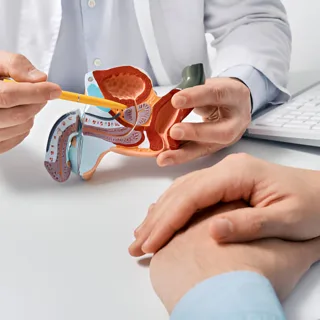







- What it is: Waking from sleep one or more times a night to pass urine, with a period of sleep before and after each trip.
- Common symptoms: Repeated night-time trips to the bathroom, broken sleep, daytime tiredness and, in older adults, a higher risk of falls.
- Conventional care: Finding the cause, evening fluid limits, sleep habits and treating conditions such as an enlarged prostate or an overactive bladder, with medicines in selected cases.
- How integrative care fits: Acupuncture, Ayurvedic therapies and individually prescribed herbs may be used alongside medical care, mainly for urinary symptoms, sleep and general wellbeing.
- Evidence at a glance: Limited for acupuncture, mostly from trials of overactive bladder and prostate enlargement; none found for Ayurveda; none found for herbal medicine for nocturia itself, with mixed results in trials for prostate-related symptoms.
What is Nocturia?
Nocturia is the need to wake up regularly during the night to urinate. To count as nocturia, the trip has to be preceded and followed by sleep, so the first urination of the morning does not count.[1]
Nocturia is one of the most common urinary symptoms and becomes more frequent with age. About half of adults over 65 get up at least once a night to void.[1] It is different from nocturnal enuresis, in which urine is passed involuntarily during sleep.[1]
Common symptoms
The main symptom is waking one or more times a night to pass urine. It often causes broken sleep, daytime tiredness, mood changes and trouble concentrating, and in older adults it is linked to falls.[1, 2]
- Repeated waking with the urge to urinate
- Trouble getting back to sleep afterward
- Daytime sleepiness or low energy
- Nighttime falls in older adults, especially with several trips a night
Causes and risk factors
Nocturia has several mechanisms: making too much urine at night, a bladder that holds too little, incomplete emptying, or a primary sleep disorder.[2] The most common underlying problem is nocturnal polyuria, meaning a larger share of urine is made at night, which can be linked to a number of medical conditions.[3]
In men an enlarged prostate is a frequent contributor, and in women an overactive bladder often is. Nocturia is also associated with diabetes, heart disease, obesity and depression.[1, 2] Sleep apnea is another recognized link, with nocturia increasing alongside apnea severity.[4] Researchers have also proposed that nocturia may be partly a circadian rhythm disorder.[5]
How it is diagnosed and treated conventionally
Evaluation starts with a medical history, questions about fluid intake and other conditions, a bladder diary, and a urine test.[2] Further evaluation may include screening for diabetes and checking how well the bladder empties.[1]
Lifestyle changes and treating underlying conditions come first. These include limiting fluids in the evening, timing diuretic medicines earlier in the day if a physician advises it, and good sleep habits.[2] Medicines are kept for people who do not respond. Desmopressin has strong evidence for nocturnal polyuria, but evidence for alpha-blockers and antimuscarinics in nocturia is more limited.[6] In frail older adults, desmopressin carries a risk of low sodium, and antimuscarinics may cause confusion and falls, so these decisions need a physician.[7]
Why Nocturia calls for a whole-person approach
Nocturia rarely has a single cause. Urine production, bladder capacity, the prostate, sleep and other health conditions can all play a part, and which ones matter differs between people.[2, 3]
Because of this, care aimed at only one factor may not be enough. Complementary care is considered around a medical evaluation, not instead of one.
Bladder and prostate conditions
An overactive bladder and an enlarged prostate are common contributors, and nocturia often accompanies overactive bladder. About half of people with daytime urgency also have nocturia.[1] Treatment for these conditions can improve nocturia when it is linked to them.[6]
Sleep
Poor sleep and nocturia feed each other. Waking for another reason can look like nocturia on a bladder diary, and more than 40% of people who wake at night have trouble falling back asleep.[1] Sleep apnea in particular is linked to night-time urination.[4]
Nighttime urine production
Making too much urine at night is the commonest underlying pathology and may be tied to other medical conditions, so a physician should look for them.[3]
Falls and age
Older adults who make several night trips are at a notably higher risk of falls and fractures, which is one reason nocturia deserves attention and not just acceptance as part of aging.[1, 2]
Acupuncture for Nocturia
What the research shows
The research is limited. We did not find a published, peer-reviewed meta-analysis of acupuncture for nocturia on its own. The evidence mostly comes from trials of overactive bladder, in which nocturia is one of several outcomes.
A Cochrane review of 15 studies (1,395 participants) of acupuncture for overactive bladder found low-certainty evidence that acupuncture may slightly reduce nocturia episodes compared with medication, based on two studies with 80 participants. Against sham acupuncture, the evidence for nocturia came from one small study and was very uncertain. All of the studies had some risk of bias, and the authors called their conclusions tentative.[8]
A 2018 meta-analysis of 10 trials with 794 patients found that electroacupuncture may be more effective than sham electroacupuncture for reducing 24-hour nocturia episodes, but it concluded the evidence was insufficient and larger, higher-quality trials are needed.[9] An umbrella review of seven reviews rated confidence in them as critically low or low and said the findings should be considered carefully.[10]
For men with prostate enlargement, a meta-analysis of eight trials (661 men) found a short-term improvement in symptom scores with acupuncture over sham, but no significant effect at 12 to 18 weeks, and said clinical importance needed more study.[11] A small pilot trial of 29 men found that moxibustion added to medication improved symptom scores, including the nocturia item, compared with medication alone, but it had no placebo group.[12]
Acupuncture has also been studied for insomnia. A meta-analysis of 24 trials found that acupuncture improved sleep scores compared with medication, mainly after more than three weeks, though results varied widely between studies.[13]
How acupuncture may work
We did not find studies that explain how acupuncture might change nocturia in people, so we do not make a claim about its mechanism. The reviews above report outcomes, not how those outcomes might arise.
What treatment involves
Treatment uses fine, sterile, single-use needles placed at points on the lower abdomen, lower back, legs and sometimes the ears, usually left in place for about 20 to 40 minutes. A course is typically several visits, with reassessment to see whether symptoms are changing. Electroacupuncture or moxibustion may also be used.
Serious problems are rare. In prospective studies, about 9 in 100 patients had a minor reaction such as bleeding, pain or redness at a needle site, and serious events occurred in about 1 in 10,000 patients.[14] Tell the practitioner first if you have a bleeding disorder, take blood thinners, are pregnant, or have a pacemaker (relevant to electroacupuncture).
Ayurvedic medicine for Nocturia
The Ayurvedic view
Ayurveda does not describe nocturia as a single condition. Frequent urination is traditionally discussed under urinary disorders linked to Vata imbalance, kidney and bladder weakness, or aggravated Kapha, depending on the person. These are traditional frameworks used to choose care, not biomedical diagnoses.
Therapies that may be used
Care is individualized and traditionally may combine:
- Diet and daily routine, including regular meals, a calm evening, and a steady bedtime
- Warm oil massage of the lower back and abdomen
- Herbs selected by the practitioner, from tested sources
- Breathing and relaxation practices for sleep
In the modern evaluation, evening fluid limits and treatment of the cause remain the basis of care.[2] Panchakarma procedures are not appropriate during pregnancy, acute illness or frailty, which includes many older adults with night-time falls, and they should not be started before the cause of nocturia has been medically assessed.
What the research shows
We found no clinical trials of Ayurvedic treatment or Panchakarma for nocturia, so the evidence for the condition is none. Any benefit remains unknown. Because a fifth of Ayurvedic products bought online contained detectable lead, mercury or arsenic in one study, product quality matters.[15]
Herbal medicine for Nocturia
Herbs and formulas that have been studied
Most herbal research touches nocturia only indirectly, through prostate enlargement and overactive bladder. Studied products include the extract of saw palmetto (Serenoa repens) and Chinese patent formulas such as Jingui Shenqi pill and Guizhi Fuling capsule used for prostate symptoms.[16, 17]
What the research shows
Evidence for nocturia itself is none, and for prostate-related urinary symptoms it is limited and mixed. A 2023 Cochrane review of 27 trials (4,656 participants) concluded that saw palmetto alone provides little to no benefit for urinary symptoms from an enlarged prostate.[16]
A network meta-analysis of 107 trials (11,037 men) found that many Chinese herbal formulas added to conventional medicine did better than conventional medicine alone, but the studies had some concerns about quality, and the authors called for more rigorous research.[17] These trials were in men with prostate enlargement, and the results should not be assumed to apply to nocturia in general.
A review of herbal supplements marketed for urinary symptoms found scant scientific evidence of safety and efficacy, and none of the 27 products it examined contained only ingredients supported by evidence.[18]
Safety and herb-drug interactions
Herbs are active substances and can interact with medicines. Reviews describe interactions with blood thinners, blood pressure medicines including diuretics, and other drugs.[19] Because nocturia is often managed with medicines for blood pressure, the prostate or the bladder, tell us about all of them before any herb is considered.
Tell us if you are pregnant or breastfeeding or have liver or kidney disease. Herbs should come from tested sources, as some Ayurvedic products contain lead, mercury or arsenic.[15]
Translating traditional medicine into modern biological language
This is interpretation, not equivalence. Chinese medicine often links frequent night-time urination with weakness of kidney yang or kidney qi, and with a bladder that does not hold. Modern medicine looks instead at how much urine is made at night, how much the bladder holds, and how the prostate and nervous system affect emptying.[2]
Ayurveda's idea of Vata governing movement and downward flow loosely parallels the nervous system's control of voiding. Researchers also describe nocturia as related to circadian timing of urine production, which may loosely parallel the traditional emphasis on regular daily routine.[5] None of these terms has been shown to correspond to a specific biological process.
How this care fits with your medical care
Complementary care for nocturia works alongside your physician and does not replace them. We do not diagnose the cause of nocturia or manage underlying conditions such as diabetes, prostate enlargement or sleep apnea, and we do not prescribe or change prescription drugs. Do not stop or change prescribed medicines, including desmopressin, alpha-blockers or diuretics, without your prescriber.
Please bring your diagnosis if you have one, a bladder diary or a note of how many times you wake at night, a full list of medicines and supplements, and recent test results. Medical evaluation of new or worsening night-time urination is important, because the cause may be treatable.[1]
When to seek urgent medical care
Some changes alongside night-time urination point to a more serious problem and need prompt medical attention.
- Blood in the urine
- Fever, chills or burning with urination, or pain in the side or back
- Being unable to pass urine, or a painful, swollen lower abdomen
- Very high thirst and urine output with weight loss or unusual fatigue, which can signal diabetes
- Loss of bladder or bowel control, or new numbness in the groin or inner thighs
- Falls or fainting during night-time trips to the bathroom
If any of these occur, call 911 or go to the nearest emergency department.
Frequently asked questions
What is nocturia?
Nocturia is waking from sleep one or more times during the night to urinate. It becomes more common with age and can come from making too much urine at night, a bladder that holds less, a prostate problem, sleep apnea or other medical conditions. It can interrupt sleep and, in older adults, raise the risk of falls, so a physician should look for the cause.
Can acupuncture help with nocturia?
It may help in some situations, but the evidence is limited. Reviews of acupuncture for overactive bladder suggest it may modestly reduce nocturia episodes, with low or very low certainty evidence and small studies. There are no large, high-quality trials of acupuncture for nocturia by itself. Results vary, and acupuncture is used alongside medical evaluation and care.
Does Ayurvedic or herbal medicine work for nocturia?
We found no clinical trials of Ayurvedic treatment for nocturia. For herbs, research mostly covers prostate enlargement. A Cochrane review found saw palmetto alone gave little to no benefit, while some Chinese herbal formulas added to medicine showed benefit in lower-quality trials. Herbs can interact with medicines and are only used when prescribed individually.
Can I stop my prostate or bladder medicine if I have acupuncture?
No. Acupuncture, Ayurveda and herbal medicine are complementary care. Do not stop or change any prescribed medicine, including medicines for the prostate, bladder or blood pressure, without talking to your prescriber. If you have blood in your urine, cannot pass urine, or have fever with urinary symptoms, you need prompt medical care.
How soon might I notice a change with acupuncture?
It differs from person to person and no result can be promised. Sleep studies of acupuncture found benefit mostly after more than three weeks of treatment, but those studies were not about nocturia. We reassess after a short course of visits to see whether treatment is helping, and we ask you to keep tracking your night-time trips.
Does insurance cover acupuncture for nocturia?
It may. Netra Integrative Health Clinic accepts most major insurance plans that include out-of-network acupuncture benefits, for example Aetna, Blue Cross Blue Shield, Cigna and UnitedHealthcare, and offers a free benefits check. HSA and FSA cards and CareCredit are also accepted. Call (908) 402-7301 to ask about your plan.
References
- Leslie SW, Sajjad H, Singh S. Nocturia. StatPearls [Internet]. 2024. PMID 30085529. StatPearls chapter on nocturia covering the definition, prevalence, consequences including falls, associated conditions, and evaluation with a voiding diary and urinalysis.
- Getaneh FW, Sussman RD, Iglesia CB. Nocturia: Evaluation and Management. Am Fam Physician. 2025;111(6):515-523B. PMID 40531150. American Family Physician review on nocturia evaluation and management, covering four mechanisms, first-line lifestyle measures such as evening fluid limits, and when to use medicines.
- Robinson D, Suman S. Managing nocturia: The multidisciplinary approach. Maturitas. 2018;116:123-129. PMID 30244773. Review of causes of nocturia, especially nocturnal polyuria, and a multidisciplinary approach to management.
- Di Bello F, Napolitano L, Abate M, et al. "Nocturia and obstructive sleep apnea syndrome: A systematic review". Sleep Med Rev. 2023;69:101787. PMID 37167825. Systematic review linking nocturia with obstructive sleep apnea, with nocturia increasing alongside sleep apnea severity.
- Kim JW, Moon YT, Kim KD. Nocturia: The circadian voiding disorder. Investig Clin Urol. 2016;57(3):165-73. PMID 27195315. Review proposing that nocturia be viewed partly as a circadian voiding disorder, drawing on sleep science and chronobiology.
- Gordon DJ, Emeruwa CJ, Weiss JP. Management Strategies for Nocturia. Curr Urol Rep. 2019;20(11):75. PMID 31707521. Review of nocturia management by mechanism, noting behavioral measures first and strong evidence for desmopressin in nocturnal polyuria.
- Wolff DT, Adler KA, Weinstein CS, et al. Managing Nocturia in Frail Older Adults. Drugs Aging. 2021;38(2):95-109. PMID 33230803. Review of nocturia management in frail older adults, emphasizing behavioral measures and safety concerns with desmopressin and antimuscarinics.
- Hargreaves E, Baker K, Barry G, et al. Acupuncture for treating overactive bladder in adults. Cochrane Database Syst Rev. 2022;9(9):CD013519. PMID 36148895. Cochrane review of 15 studies (1,395 participants) of acupuncture for overactive bladder, with low to very low certainty evidence including for nocturia episodes.
- Zhao Y, Zhou J, Mo Q, et al. Acupuncture for adults with overactive bladder: A systematic review and meta-analysis of randomized controlled trials. Medicine (Baltimore). 2018;97(8):e9838. PMID 29465566. Meta-analysis of 10 trials (794 patients) of acupuncture for overactive bladder, suggesting electroacupuncture may reduce nocturia episodes but with insufficient evidence.
- Ma J, Ren F, Lu S, et al. Acupuncture therapy of overactive bladder: An umbrella review and meta-analysis. Arab J Urol. 2025;23(1):75-83. PMID 39776552. Umbrella review of seven systematic reviews of acupuncture for overactive bladder, with critically low to low review confidence and mostly low-quality evidence.
- Zhang W, Ma L, Bauer BA, et al. Acupuncture for benign prostatic hyperplasia: A systematic review and meta-analysis. PLoS One. 2017;12(4):e0174586. PMID 28376120. Meta-analysis of eight trials (661 men) of acupuncture for prostate enlargement, finding short-term symptom score improvement over sham but not at medium term.
- Lee HY, Bae GE, Lee SD, et al. Moxibustion as an adjunct for lower urinary tract symptoms associated with benign prostate enlargement: A randomized controlled pilot trial. Medicine (Baltimore). 2020;99(4):e18918. PMID 31977907. Pilot trial of 29 men finding moxibustion added to medication improved prostate symptom scores, including nocturia, compared with medication alone; no placebo group.
- Kim SA, Lee SH, Kim JH, et al. Efficacy of Acupuncture for Insomnia: A Systematic Review and Meta-Analysis. Am J Chin Med. 2021;49(5):1135-1150. PMID 34049475. Meta-analysis of 24 trials of acupuncture for insomnia, finding improved sleep scores versus medication after about three weeks, with high heterogeneity.
- Bäumler P, Zhang W, Stübinger T, et al. Acupuncture-related adverse events: systematic review and meta-analyses of prospective clinical studies. BMJ Open. 2021;11(9):e045961. PMID 34489268. Systematic review of 21 prospective studies finding minor acupuncture reactions in about 9 percent of patients and serious events in about 1 per 10,000.
- Saper RB, Phillips RS, Sehgal A, et al. Lead, mercury, and arsenic in US- and Indian-manufactured Ayurvedic medicines sold via the Internet. JAMA. 2008;300(8):915-23. PMID 18728265. JAMA study finding detectable lead, mercury or arsenic in about one fifth of Ayurvedic medicines purchased over the Internet.
- Franco JV, Trivisonno L, Sgarbossa NJ, et al. Serenoa repens for the treatment of lower urinary tract symptoms due to benign prostatic enlargement. Cochrane Database Syst Rev. 2023;6(6):CD001423. PMID 37345871. Cochrane review of 27 trials (4,656 participants) concluding that saw palmetto alone gives little to no benefit for urinary symptoms from prostate enlargement.
- Zeng H, Wang Z, Zhu W, et al. Comparative efficacy of commercial oral poly-herbal traditional Chinese medicine formulations combined with western medicine in benign prostatic hyperplasia management: a systematic review and network meta-analysis. Front Pharmacol. 2024;15:1358340. PMID 38904002. Network meta-analysis of 107 trials (11,037 men) of Chinese herbal formulas plus conventional medicine for prostate enlargement, with some concerns about study quality.
- Nabavizadeh R, Zangi M, Kim MM, et al. Herbal Supplements for Prostate Enlargement: Current State of the Evidence. Urology. 2018;112:145-150. PMID 29107129. Review of 27 herbal supplements marketed for prostate-related urinary symptoms, finding scant evidence of safety and efficacy.
- Hu Z, Yang X, Ho PC, et al. Herb-drug interactions: a literature review. Drugs. 2005;65(9):1239-82. PMID 15916450. Literature review of clinically significant herb-drug interactions, including effects with blood thinners, diuretics and other drugs.
This page is for general education and is not medical advice. Acupuncture, Ayurvedic medicine and herbal medicine are complementary therapies; they do not replace diagnosis or treatment by your physician. Do not stop or change prescribed treatment without talking to your prescriber. In an emergency call 911.